Insider Brief
- India’s first satellite, Aryabhata, launched in 1975, marked a pivotal moment for low-income nations in demonstrating independent space capability.
- Built entirely in India and launched from the Soviet Union, Aryabhata served as a training platform for Indian scientists and established ISRO’s long-term technical foundation.
- Despite early in-orbit failures, the satellite operated successfully for nearly two years and symbolized India’s blend of scientific ambition and cultural heritage.
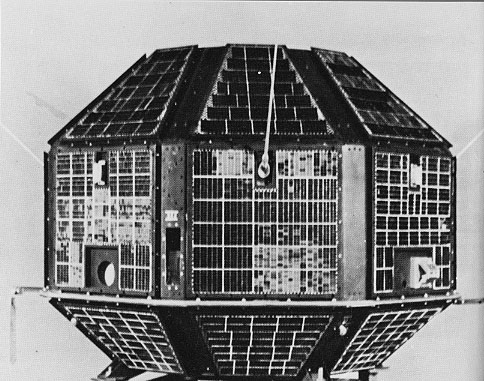
Image: ISRO Wikimedia
Fifty years ago, a group of young Indian scientists launched a small satellite that quietly reshaped how nations think about space.
In the early hours of April 19, 1975, India entered the space age from a Soviet military launch site near the Caspian Sea. With the help of a Kosmos-3M rocket and a Soviet partnership, the Indian-built satellite Aryabhata was sent into orbit — a modest 358-kilogram polyhedron that marked a bold statement from a country still rebuilding less than three decades after colonial rule.

The satellite itself was unremarkable by global standards. But as science historian Pranav Sharma writes in Nature, Aryabhata redefined what a low-income country could achieve in space. It wasn’t just India’s first satellite; it was a demonstration that scientific sovereignty and global relevance were possible without deep pockets or foreign blueprints.
A Satellite Built for Learning
The Indian Space Research Organisation (ISRO) was still in its early stages when Aryabhata was built, Sharma writes. Many of its 200 engineers had never worked on a mission of this scale. They had previously launched small rockets and assisted with international projects, but Aryabhata was a chance to build something entirely on their own.
The satellite’s components — from its telemetry systems to its thermal insulation — were all developed in India. The goal wasn’t to compete with the superpowers in orbit but to gain experience.
“The mission served as an orbital classroom,” Sharma writes. “Its main purpose: training a new generation of space technologists and validating home-grown hardware.”
The project’s director, U. R. Rao, argued that building a communications or Earth-observation satellite would require first mastering the basics. Aryabhata was that first step, a deliberate choice to go low-tech in service of long-term capability.
A Name With Meaning
Originally called ISRO Satellite-1, the spacecraft was renamed after Aryabhata, a fifth-century Indian astronomer and mathematician whose work included calculating the value of π and proposing that the Earth rotated on its axis, Sharma writes.
The decision, made with input from then-prime minister Indira Gandhi, symbolized India’s scientific legacy and offered an alternative to the Cold War’s space race narrative.
“The name carried deep symbolism, reaffirming India’s rich history of scientific enquiry and linking ancient intellectual achievements to modern technological progress.” Sharma writes. “Politically, it also provided an alternative narrative to the cold war-era space race between the United States and the Soviet Union by reinforcing India’s unaligned stance. The country was not following global trends, it was merely reclaiming its own long-standing intellectual prowess.”
The First Test in Orbit
After launch, the satellite ran into trouble. A stuck valve relay prevented its spin system from activating, causing the spacecraft to tumble. Engineers on the ground worked for four tense days to stabilize it, and by the fifth day, a backup spin system engaged, spinning Aryabhata at 50 revolutions per minute. Mission control erupted in celebration.
The satellite had already collected useful data on X-ray sources and electrons in the Earth’s upper atmosphere. But when a power bus failure disabled the scientific experiments, the mission shifted to operating the satellite purely as a technology demonstrator, which it continued to do successfully for nearly two years.
One of its most poignant moments came when it relayed an electrocardiogram signal from Sriharikota to Bengaluru, a symbolic act that foreshadowed the future of telemedicine.
“That day,” Indian physicist Yash Pal recalled, as Sharma notes. “We heard the pulse of India in space.”
A Template for Others
Aryabhata’s legacy goes beyond India’s own success. As Sharma suggests, it offers a playbook for emerging space nations like Nigeria and Indonesia. The lesson: technical success doesn’t require lavish budgets, but rather strong institutions, local talent development, and mission-driven partnerships.
Soon after Aryabhata, India signed a deal with the Soviet Union for a second satellite, setting ISRO on a stable path. Today, ISRO provides launch services to other low- and middle-income countries, helping to grow the space ambitions of nations in Africa and Latin America.
Importantly, India chose early on to emphasize partnerships that included knowledge transfer and local control. While ISRO initially looked to NASA, it ultimately partnered with the Soviet Academy of Sciences in a way that preserved Indian leadership of the project. Sharma suggests that other countries could benefit from similarly balanced partnerships — not just hiring launch providers, but co-developing technology with long-term capability in mind.
Quiet Strength
Aryabhata didn’t aim to break records. It wasn’t a Sputnik or an Apollo. But that, Sharma argues, is part of its strength.
Instead of racing toward headlines, the satellite became a foundation. It inspired a generation of Indian engineers, helped institutionalize science and technology in the country, and demonstrated that national confidence can be built through public investment in knowledge, not spectacle.
“With space becoming increasingly commercial, contested and crowded,” he writes, “Aryabhata reminds us that the most meaningful missions are not the loudest.”